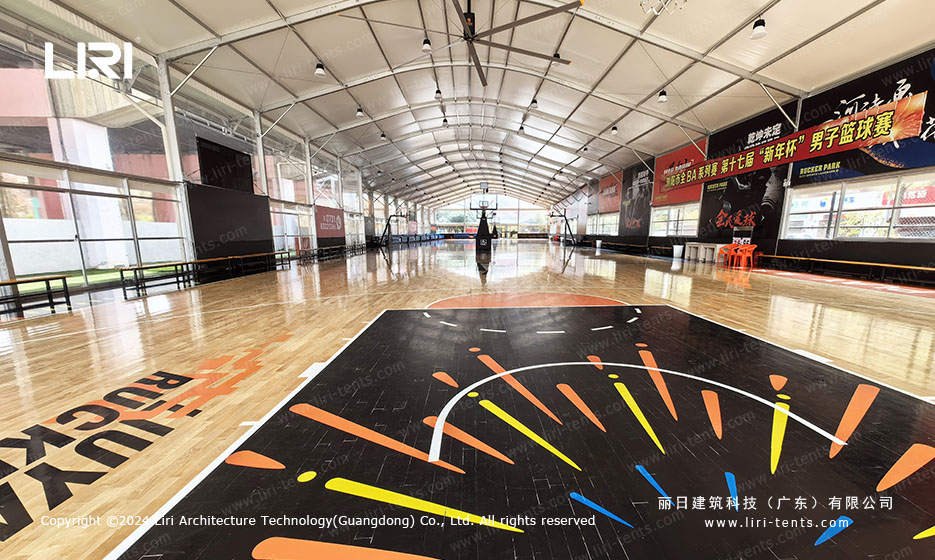
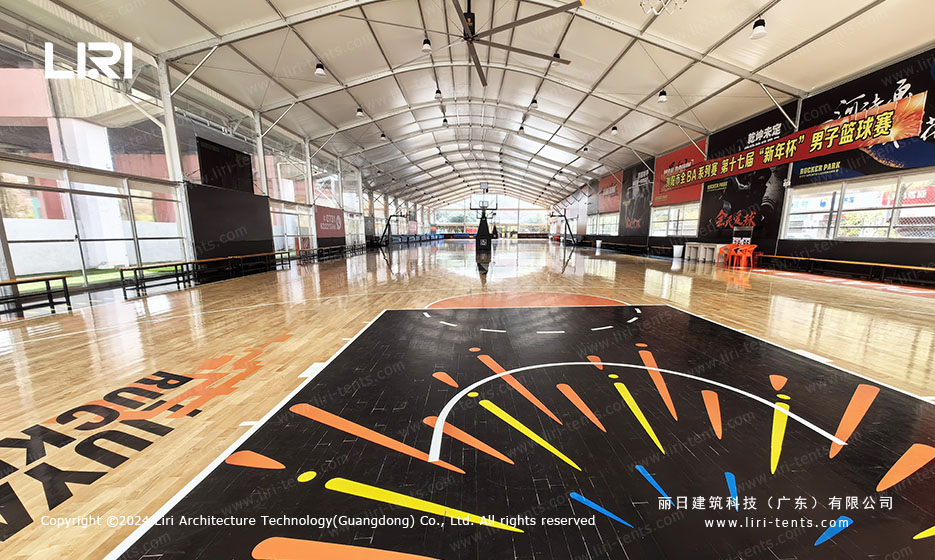
When a commercial basketball facility needs to go from bare ground to fully operational in weeks rather than months, conventional construction hits a wall of permits, weather delays, and fixed costs that can sink a project before it even opens its doors.
That is precisely why an increasing number of sports operators are turning to clear span aluminum structures as the building envelope for indoor courts-and the Liuyang Rucker Park facility in Hunan Province stands as a concrete example of how this approach delivers results on the ground.
*Interior view of the full-size basketball court housed within a curved clear span aluminum tent structure.*
How a Party Tent Becomes a Professional Basketball Venue
The structure wrapping around this regulation-size hardwood court is not a permanent brick-and-mortar hall. It is a large-span aluminum frame tent engineered specifically for long-term occupancy as an indoor basketball arena tent. The arched roof profile provides clearance well above standard rim height, and the translucent sidewalls flood the playing area with natural daylight during daytime hours-reducing artificial lighting costs by a measurable margin.
The framework itself uses 6061-T6 extruded aluminum, which carries two practical advantages for sports applications. First, it resists corrosion from humidity generated by player activity and HVAC systems. Second, the material’s strength-to-weight ratio allows for column-free spans wide enough to accommodate a full court plus spectator seating without any center support posts obstructing sightlines.
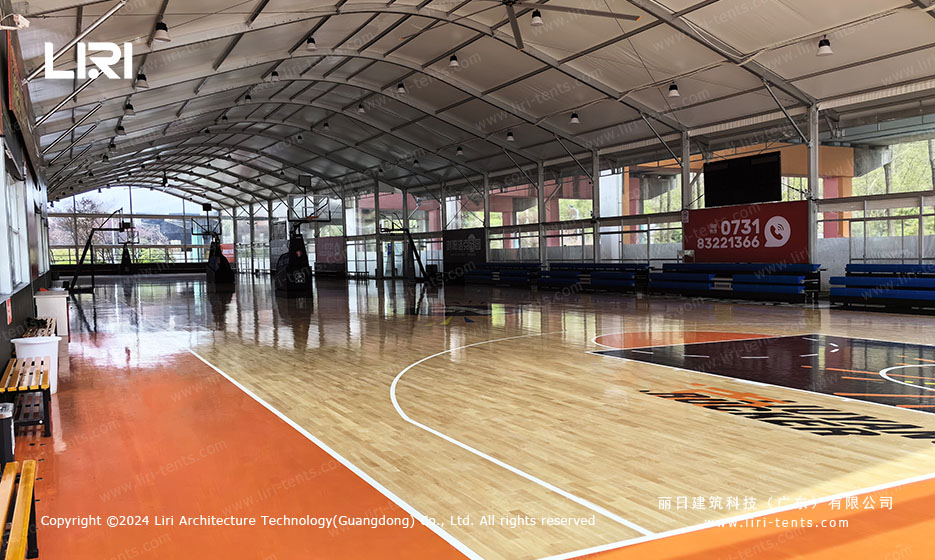
*Full court perspective showing the wooden floor, orange training zones, and tournament banners mounted along the interior walls.*
Technical Layout and Court Configuration
The Liuyang installation houses a complete regulation basketball surface with polished hardwood flooring across the primary playing area and high-grade synthetic surfacing along the sidelines. The color-blocked design-wood tone at center, orange flanking zones, and black accent sections near the baseline-serves both aesthetic branding and functional zone demarcation for drills and league play.
Multiple hoop installations are visible running down the length of the structure, which means the venue supports simultaneous practice sessions or back-to-back game scheduling. The blue bleacher banks along both sidelines provide tiered seating capacity that scales with event size-from local youth leagues to regional tournaments.
From a structural standpoint, this qualifies as a temporary sports hall in regulatory terms, but its actual service life extends far beyond what that label suggests. The PVC-coated membrane roof carries a B1 fire rating and blocks over 99% of UV radiation, which protects players, flooring materials, and any branded graphics inside from sun degradation through the sidewall glazing.
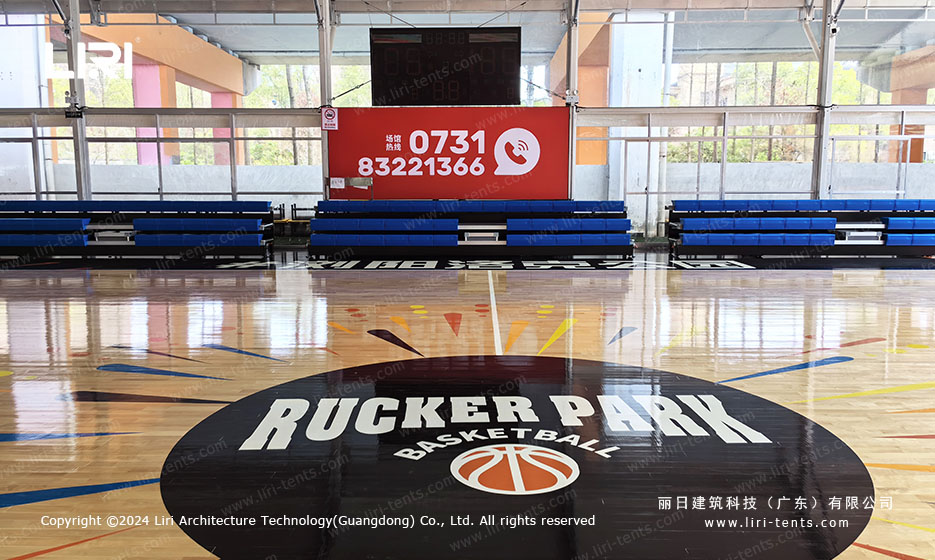
*Center circle detail displaying the “Rucker Park Basketball” court logo with radial color patterns.*
The sidewall assembly combines rigid glass panels with optional roll-up sections for ventilation-a configuration that becomes critical when a packed crowd raises interior temperature during competitive matches. Cross-ventilation through opposing sidewall openings creates airflow rates that conventional enclosed gyms struggle to match without expensive mechanical systems.
Commercial Viability and Operating Economics
Here is where the economics become difficult for traditional construction to compete against. A commercial party tent configured as a sports facility arrives at roughly one-third the capital cost of a steel-framed permanent gymnasium of equivalent footprint. The timeline from site preparation to first game tips off in 3 to 5 days with a crew of six to eight installers.
For facility operators, those numbers translate into faster revenue generation and lower break-even thresholds. The Liuyang venue hosts regular league play, skills camps, and rental sessions-all under one roof that can be relocated or resized if the business model shifts. That flexibility is simply unavailable once concrete is poured on a conventional build.
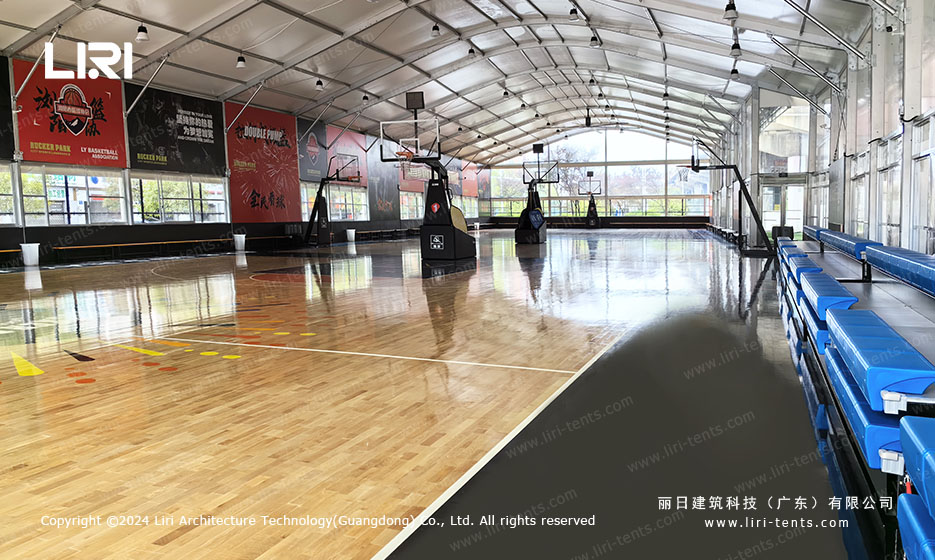
*Side-angle view revealing multiple basketball hoops, wall-mounted banners, and natural light streaming through glazed sidewalls.*
The structure also functions as a multi-purpose sports marquee beyond basketball alone. The same clear span volume accommodates futsal, badminton, fitness classes, and community events with no structural modifications required-only furniture and equipment changes. This versatility maximizes the revenue-per-square-meter metric that drives facility profitability.
Why Aluminum Frame Structures Work for Indoor Sports
The engineering behind this category of aluminum frame gymnasium has matured considerably over the past decade. Modern connection systems use patented modular joints that maintain rigidity under dynamic loads-jumping players, rebounding balls, crowd movement-while still allowing disassembly and reassembly if the structure must move to a new site.
Wind load ratings for these designs typically reach 100km/h sustained wind resistance, which covers the vast majority of weather conditions encountered in temperate and subtropical regions. The foundation system uses either ground anchors for shorter deployments or concrete footings for multi-year installations like this Hunan facility.
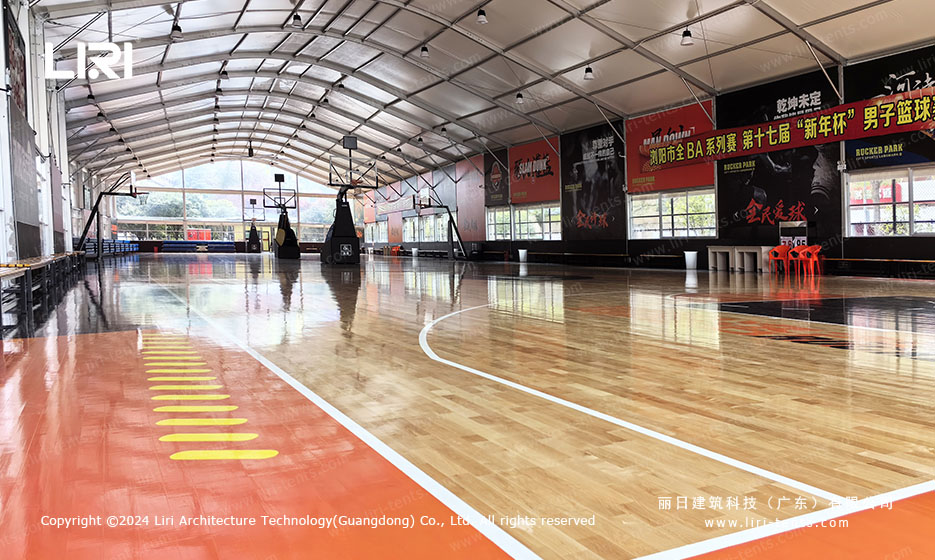
*Courtside angle highlighting the wood-orange floor transition, yellow court markings, and tournament banner displays.*
FAQ
Q: Can a sports court tent handle professional-level competition standards?
A: Yes. The clear span interior provides unobstructed ceiling heights exceeding 7 meters at the eave and over 9 meters at the ridge, which satisfies FIBA and national federation requirements for official match venues. The flat, level floor platform installed beneath the structure meets competition-grade flatness tolerances.
Q: What is the expected service life when used year-round as an indoor arena?
A: With proper maintenance-periodic tension adjustment, roof cleaning, and annual connection inspections-the aluminum frame and PVC membrane deliver a 15-year service life even under continuous occupancy conditions. Many facilities of this type have been operating for over a decade with no major component replacement.
Q: Does the structure require special permits compared to a permanent building?
A: In most jurisdictions, temporary and semi-permanent tent structures fall under a different permitting category than permanent construction, which often means streamlined approval processes and lower compliance costs. Local codes vary, so consulting with your tent supplier about specific regional requirements is the recommended first step. For detailed specifications on similar modular tent system options, the engineering documentation covers load calculations, fire performance data, and thermal properties that planning offices need.