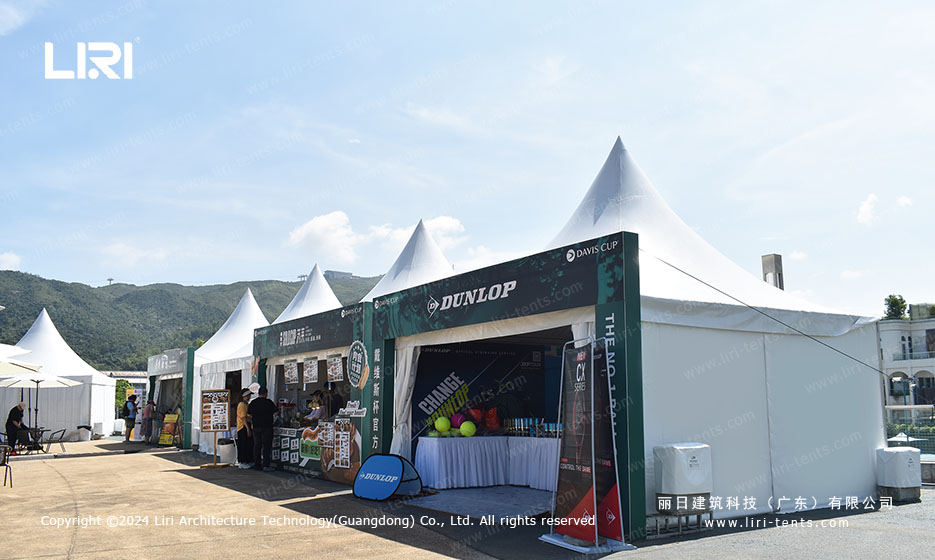
The Hengqin International Tennis Center sits on a coastal strip of Zhuhai, where early-autumn squalls off the South China Sea can break a public tournament schedule in an afternoon.
The operations team needed a tent village that matched the stadium’s footprint without anchoring into the new hardwood courts. The fix was a row of high-peak pagoda tents, each one assigned a single function so the flow from gates to courts stayed predictable.
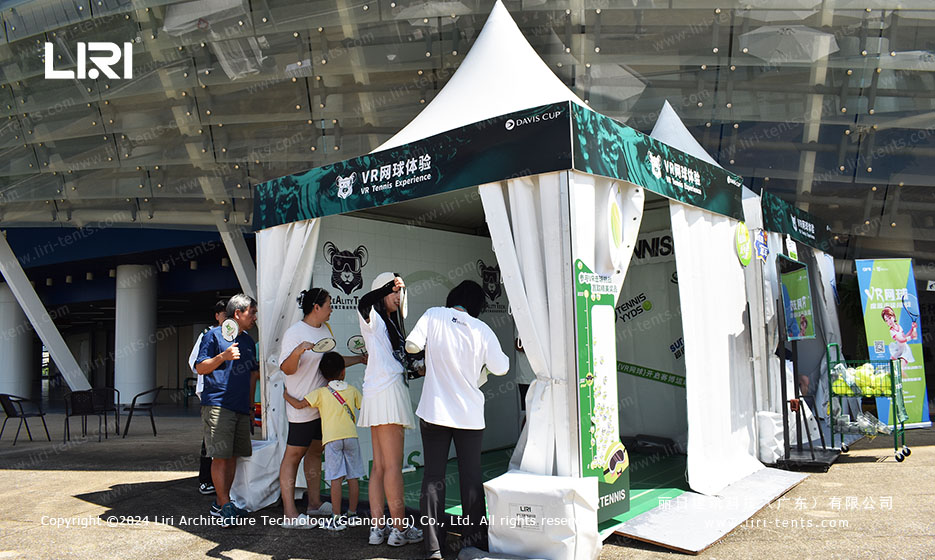
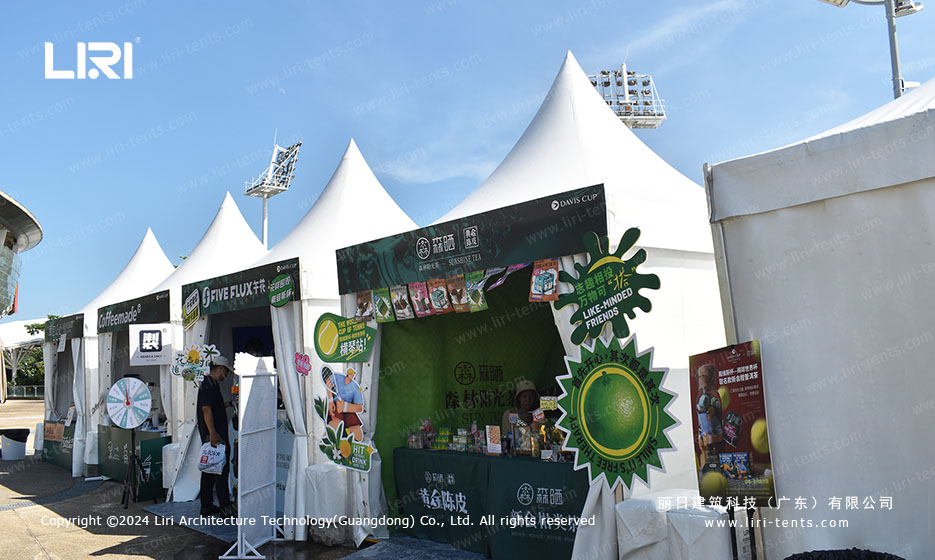
The lineup split into eight zones: a Dunlop retail tent at the main gate, a VR tennis experience pavilion two bays over, a brand activation row housing Five Plus, Coffeemani, and Like-Kinden Friends, a first-aid station, a four-bay food court, a security checkpoint under a wider A-frame, a staff and media entrance marked “Gate 4”, and a long warehouse tent against the back fence. Frames were aluminum 6061/T6 with 850 g/m² double-coated PVC covers, engineered to 100 km/h wind load.
Setting the village up took two working days. Day one was a perimeter survey and unloading hardware. Day two was frame assembly for all eight pagodas plus the storage tent, with PVC covers pulled on at sunset. Anchoring used weighted steel plates rather than ground stakes, because the venue’s surface team refused any drilling. Each 3 m × 3 m pagoda took four 25 kg plates, the 5 m × 5 m bays took six. The same approach is documented for the tennis court shelter built at the same venue a year earlier, where the wider span demanded a heavier plate cluster.
The brand activation row gave the organizers the most flexibility. Three adjacent high peak tents at 5 m × 5 m each were joined by rain gutters along the ridge, so visitors walking between booths stayed dry. The aluminum frame held within the engineered deflection limit against a 60 km/h gust, with half-height PVC sidewalls protecting merchandise from sea spray. The same modular approach is what makes pagoda tents for food festivals viable at higher-wind coastal venues.
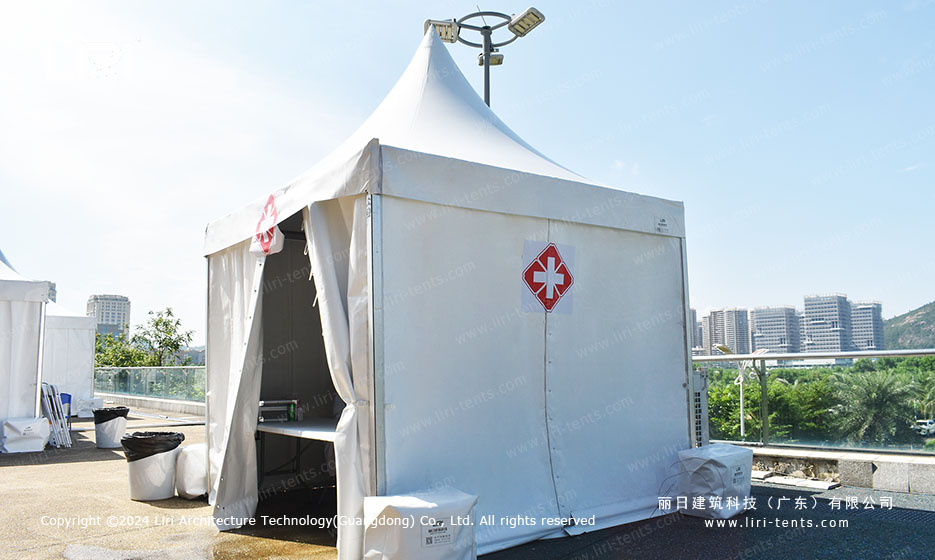
The medical tent was a single 3 m × 3 m pagoda placed within 30 m of the stadium exit, with white opaque PVC walls and a red cross decal on each face. Inside held a stretcher, an AED, a cooling fan, and a small refrigerator for cold packs. A second identical canopy tent served as a triage annex during peak crowd windows. Medical staff reported inside temperatures 4°C to 6°C below the deck reading across the afternoon.
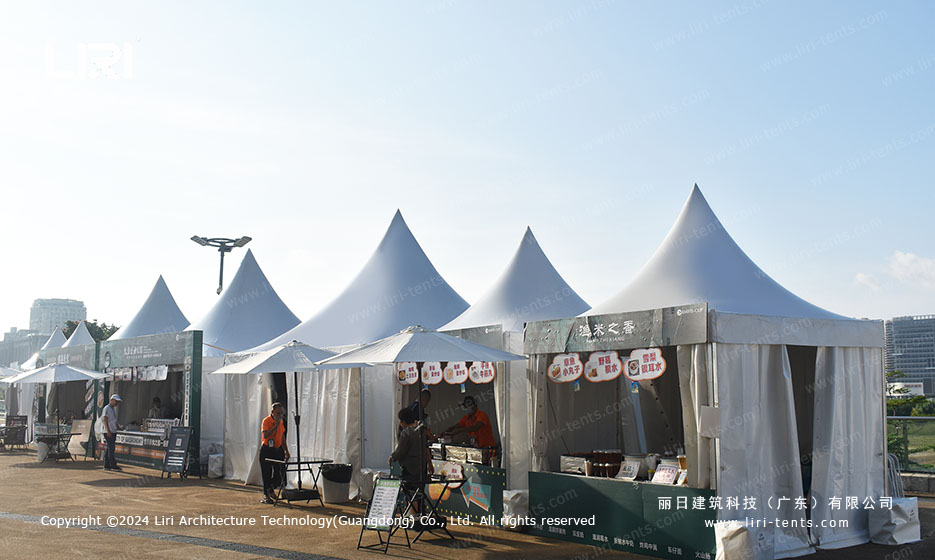
The food court used four 5 m × 5 m pagodas in a line, each leased to a different vendor. A continuous counter ran along the front, with a single gutter above linking the roofs. Total serving capacity hit roughly 600 meals per hour, keeping the queue under a five-minute wait. For organizers weighing a similar setup at a marathon village, the same gutter system lets a small footprint expand without losing visual identity.
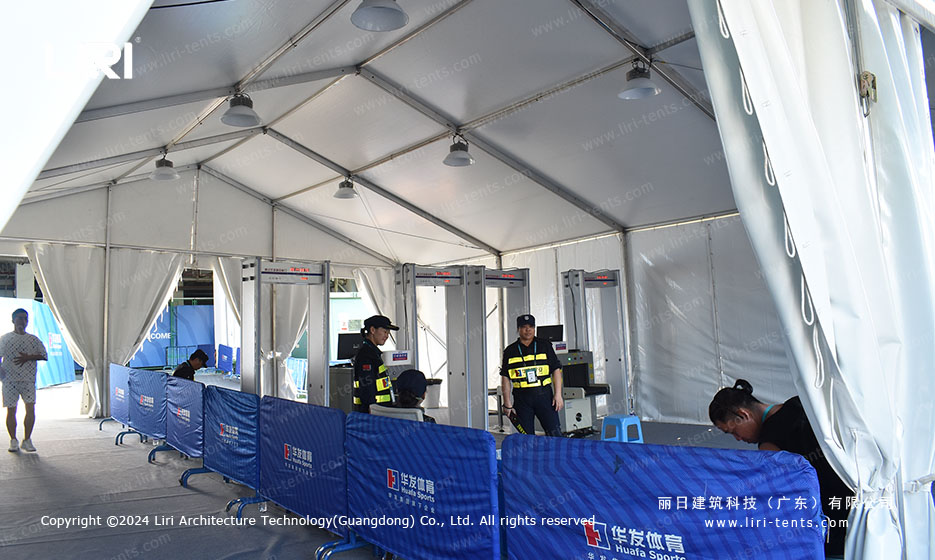
The security checkpoint was a wider A-frame, 6 m × 9 m, with three walk-through metal detector gates across the entrance. Security staff sat at folding tables behind branded barriers, and the clear span tent roof cleared the gate electronics by 3.5 m, leaving room for overhead lighting. The aluminum frame kept the entrance calm in 50 km/h crosswinds.
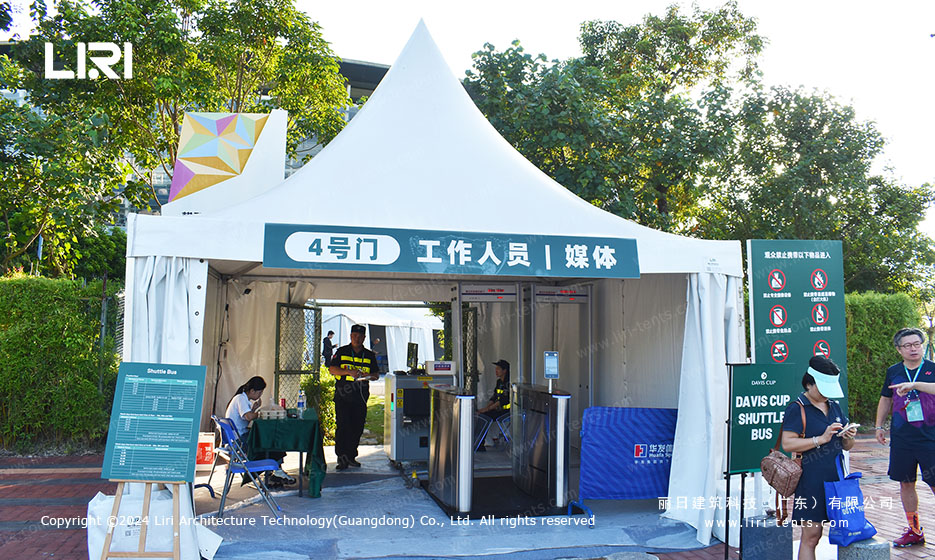
The “Gate 4” staff and media tent was the same 5 m × 5 m pagoda used elsewhere, with a custom printed valance around the eave and a sign panel on the front gable. Inside held a registration desk, a Shuttle Bus schedule board, and a credential scanner. A second pagoda served staff tea service.
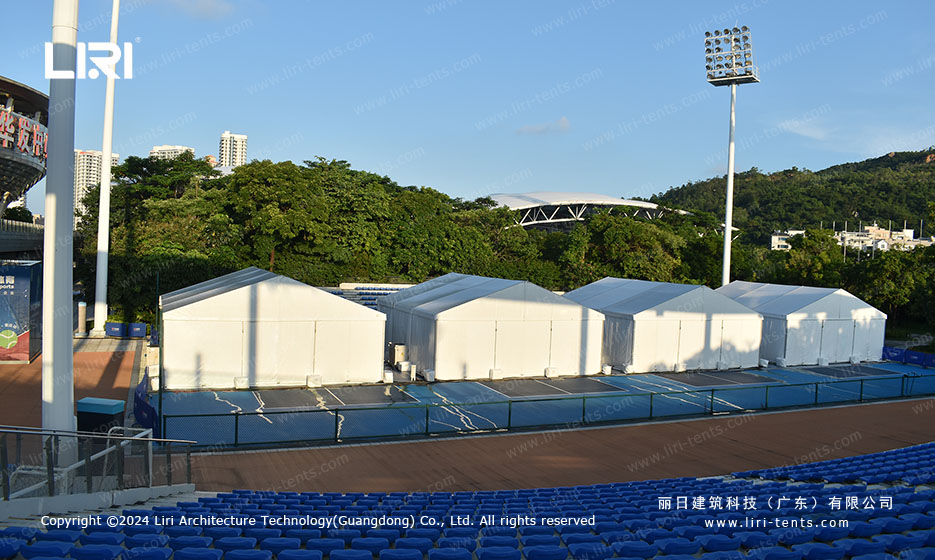
The storage tent was the only A-frame in the village, set 10 m × 15 m against the back fence. It held spare seats, signage, the spare court nets, the walkie-talkie charging rack, and the on-site generator. The team spec’d event tent walls at full height to keep wind off the generator, with a small pagoda at the entrance for covered loading. Aerial shots make the warehouse tent easy to miss, but it carries roughly 30% of the daily load.
Hengqin Tennis Village Specs at a Glance
- Frame: Aluminum 6061/T6, anodized
- Fabric: 850 g/m² double-coated PVC, white, UV-blocked
- Connectors: Hot-dip galvanized steel, cast aluminum
- Wind: 100 km/h service, 120 km/h peak
- Temp range: -30°C to +70°C
- Fire: DIN 4102 B1, NFPA 701
- Options: ABS walls, glass walls, gutters, cassette flooring, lining
Why Pagoda Tents Fit a Coastal Tennis Venue
Three reasons. The high-peak roof sheds sudden rain without collecting water, which matters in typhoon season. The modular frame lets the team add or remove a bay in a day, so the village can flex to the next event on the venue’s calendar. White PVC reflects the coastal sun and keeps the inside 6°C to 8°C cooler than the deck. For organizers looking at outdoor pagoda tents for a sports event, the same package covers VIP lounges, retail, and back-of-house in a single visual language.
What pagoda tent size fits a single VIP lounge at a tennis event?
A 5 m × 5 m pagoda holds roughly 12 seated guests or 20 standing with a refreshment counter. For a 30-person VIP lounge, scale to 6 m × 12 m or join two 5 m × 5 m pagodas with a rain gutter.
Can a coastal tennis venue anchor tents without drilling into the courts?
Yes. The Hengqin setup used weighted steel plates on the existing paving. Each 3 m × 3 m pagoda took four 25 kg plates. No ground stakes, no drilling, no surface damage.
How long does a multi-zone pagoda tent village take to install?
Two days for the Hengqin eight-tent village with a five-person crew. Day one for site survey and frame assembly, day two for fabric, gutters, and sidewall installation.