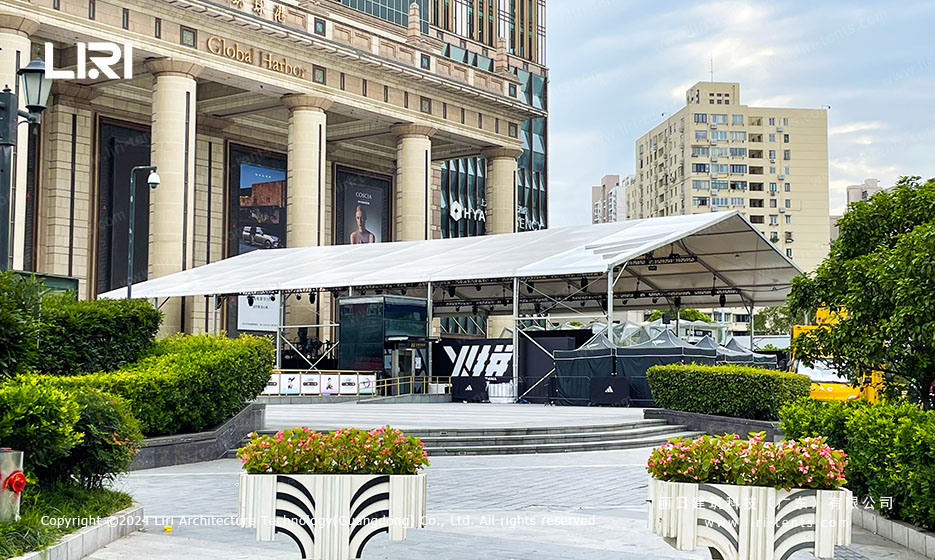
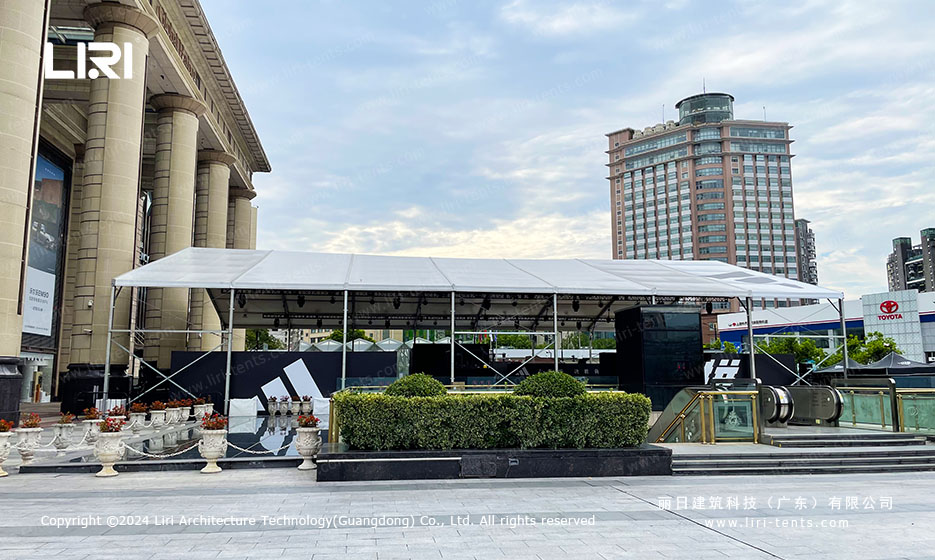
When a global sportswear brand staged a flagship fan-experience event in downtown Shanghai, the venue had to do more than shelter an audience. It had to host a regulation basketball court, hold up hundreds of kilograms of lighting and LED rigging, survive an open-air city-square location, and look camera-ready against a backdrop of glass towers. The site was a paved plaza outside a major shopping mall in the Hongqiao district. The structure was a clear span tent on an aluminum frame, the largest in the EBT series at 25 m wide. Setup took three days; the resulting venue ran for a week-long basketball-themed activation that drew steady crowds from the surrounding retail traffic.
The Setup Problem in a Tight Urban Plaza
The brief was deceptively simple: a 25 m × 50 m clear-span event tent with no internal columns, sited on a tiled plaza open to the public during installation. There was no room for guy ropes, the floor was finished stone, and the surrounding buildings created a wind-tunnel effect. The large party tent chosen had to solve four problems at once: load, footprint, finish, and weather.
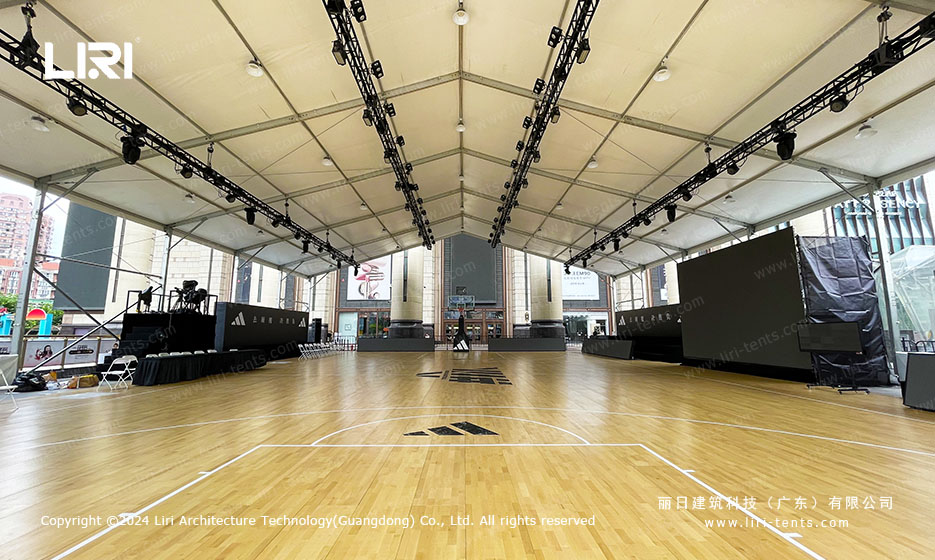
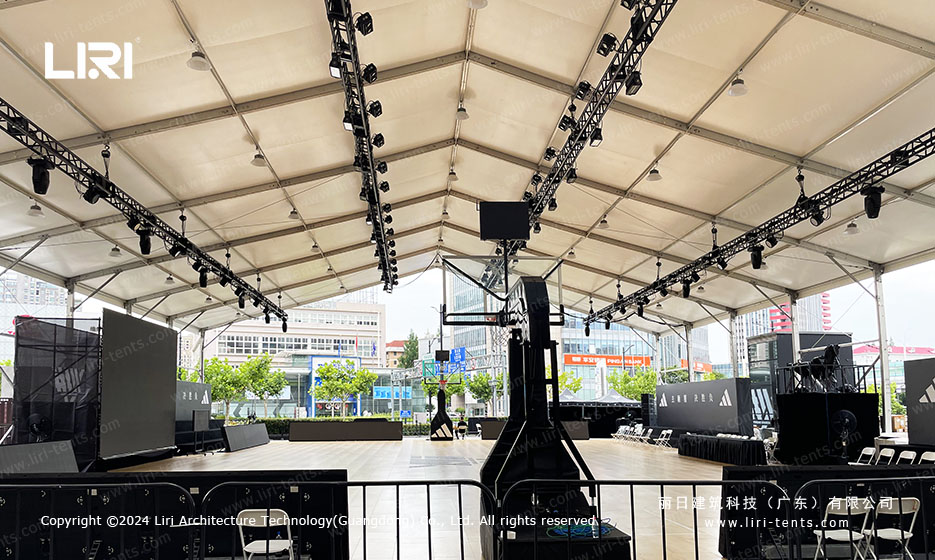
Load capacity was the most underestimated variable. A full basketball court with hardwood flooring weighs 4.5 tonnes. Add a lighting truss grid, two 6 m × 4 m LED walls, a perimeter barrier, and 200 stacked chairs, and total dynamic load climbs above 12 tonnes. The aluminum frame uses 300 mm × 120 mm × 4 mm main profile sections with reinforced node brackets, rated for 0.6 kN/m² roof loads and 100 km/h wind allowance when ballasted.
Footprint, Ballast, and the Hard-Pavement Problem
Footprint is where clear-span design earns its name. A 25 m EBT clears 625 m² of unobstructed floor area, with 4 m side heights and an 8.5 m ridge. The frame is modular on a 5 m bay grid, so it can be reconfigured for any future site from 10 m × 10 m up to 30 m × 60 m without changing the structural logic. The same hardware that hosted this Shanghai event has been redeployed as a commercial party tent at trade shows, automotive launches, and product tours across the region.
Ballast on a paved plaza is solved with concrete block weights rather than ground stakes. Each base plate carried 1.2-tonne precast blocks, totaling 28 tonnes. Wind monitoring on site fed a live readout to the production manager; the structure is rated to remain stable at 100 km/h sustained winds with all sidewalls closed. This ballast strategy is identical to what we use on any clear top party tent installed on rooftops or podium decks.
Finish, Branding, and the Camera-Readiness Test
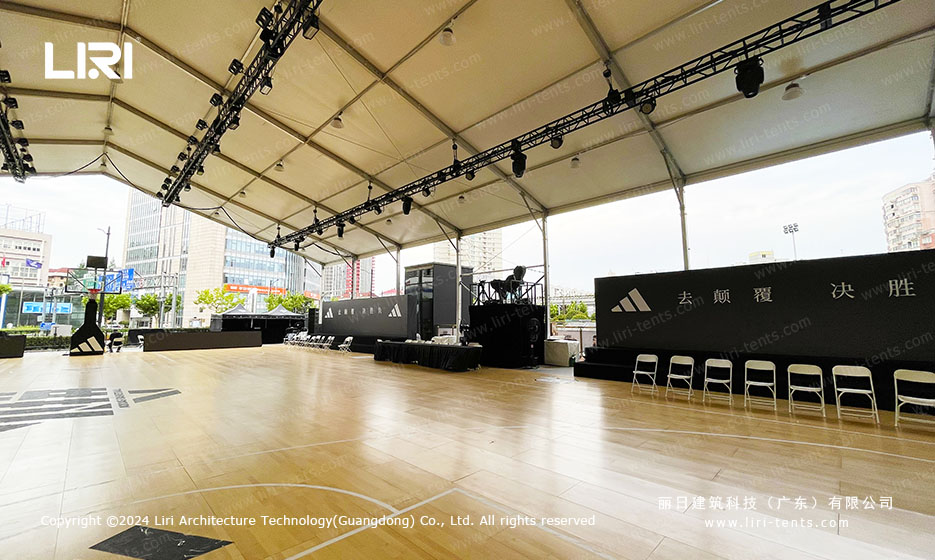
For a brand activation, the tent is also a backdrop. The PVC roof is an 850 g/m² coated polyester in bright white, with a translucent weave that lets through 12% of daylight for soft, even fill light on the court. Translucent fabric removes the need for daytime uplighting and keeps the LED walls visible in any ambient condition. Sidewalls are the same fabric in 650 g/m² grade, with full-length zippered panels that open to merge the tent interior with the surrounding plaza on launch moments.
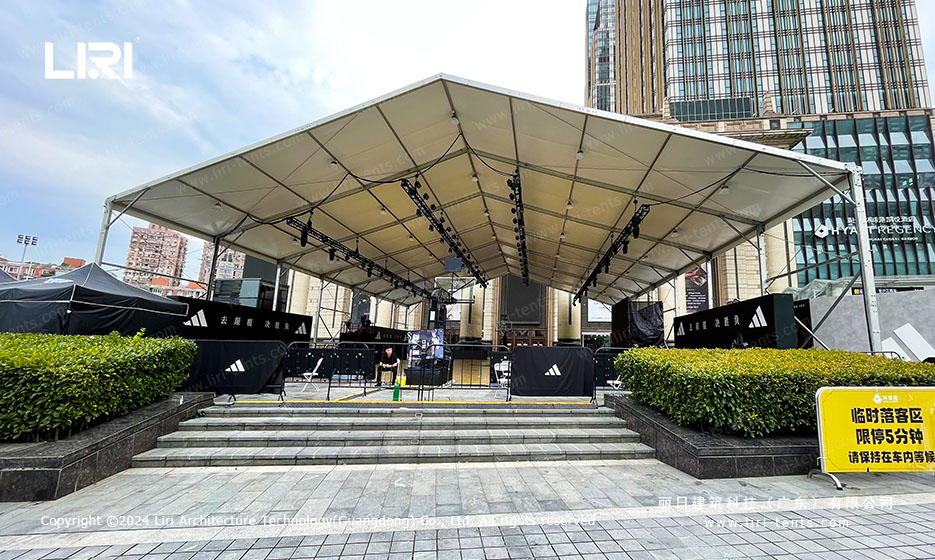
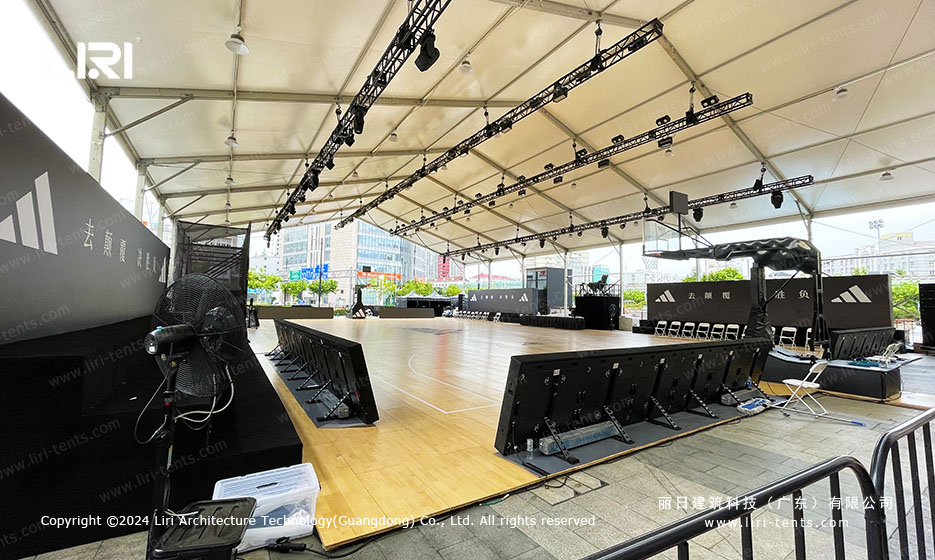
Brand graphics were printed on separate tensioned PVC panels and clipped to the frame rather than welded to the roof fabric, so the host custom party tent can return to plain white for the next event without losing any structural fabric. The three-stripe motif and player silhouettes were applied at the entrance gable, on the LED sidewalls, and as a back-of-court banner without modifying the tent.
Inside the Rigging: Audio, Light, and LED
The tent’s roof doubles as a rigging grid. The aluminum rafters are rated to accept 200 kg point loads at each cross-beam, giving the rigging crew 40 rigging points across the 25 m × 50 m ceiling. The combined rigging weight on the EBT structure was 3.4 tonnes, well within the engineering envelope. Clear height at the eaves is 4 m, enough to fly a lighting truss at 5.5 m and still leave 4 m of headroom above the basketball backboard at 3.05 m. The outdoor party tent hardware disappears behind the production design, which is the goal for any sponsored activation.
The Result: One Tent, Five Operating Modes
Over the seven-day run, the venue served five configurations: press check-in, brand training clinic, public open court hours, media tournament, and a finals day with attendance above 1,500. The site team also reused the structure as a hospitality lounge for an adjacent product launch. A 25 m × 50 m EBT can be dismantled, packed into 40 ft containers, and shipped to the next city in 36 hours. The aluminum is hot-dip galvanized to ISO 1461 and the PVC fabric is UV-treated for 8 to 10 years of service. For any organizer running a multi-city campaign, the aluminium tent format pays for itself after the second or third deployment.
Frequently Asked Questions
Q: How does a clear span tent anchor on a finished stone plaza where ground stakes are not allowed?
A: Every column sits on a steel base plate weighted with precast concrete blocks, typically 1.0 to 1.5 tonnes per anchor. The Shanghai installation used 28 tonnes of ballast across 16 anchor points, with no penetration of the stone surface. The same approach is used for any large party tent on rooftops, podium decks, or finished public spaces.
Q: Can a 25 m clear span tent hold a full basketball court and a lighting grid at once?
A: Yes. The EBT frame was rated for 0.6 kN/m² distributed roof load and 200 kg point load per cross-beam; the actual load was 0.4 kN/m² with 3.4 tonnes of rigging. The frame geometry gives clearance to fly a lighting truss at 5.5 m above a regulation 3.05 m backboard, so the court and the production rigging share one integrated volume.
Q: What happens to the structure during the high-wind months on the Yangtze coast?
A: The EBT frame is rated for 100 km/h sustained wind with all sidewalls closed and the base plates fully ballasted. The production team monitors a live anemometer on site, and the sidewalls zip closed inside 10 minutes. The aluminum frame is hot-dip galvanized to ISO 1461, so salt air does not shorten hardware life. We recommend a 24-hour weather watch window for any commercial party tent activated along the coast during the typhoon months.
Q: How is brand signage attached without damaging the tent fabric?
A: Signage panels are tensioned on independent PVC carriers and clipped to the aluminum frame at the gable, eaves, and cross-beam points. No glue, no welding, and no stitching touch the structural fabric. The same tent can carry a basketball-themed identity one week, an automotive reveal the next, and a plain white event the week after.
Get in Touch
Send us your venue dimensions, capacity, and any rooftop, plaza, or hard-surface constraints. We will return a stamped frame layout, a ballast specification, and a quote for the EBT series in 25 m, 30 m, and 40 m clear spans. Lead time for an EBT 25 m × 50 m is 25 days from order to install.