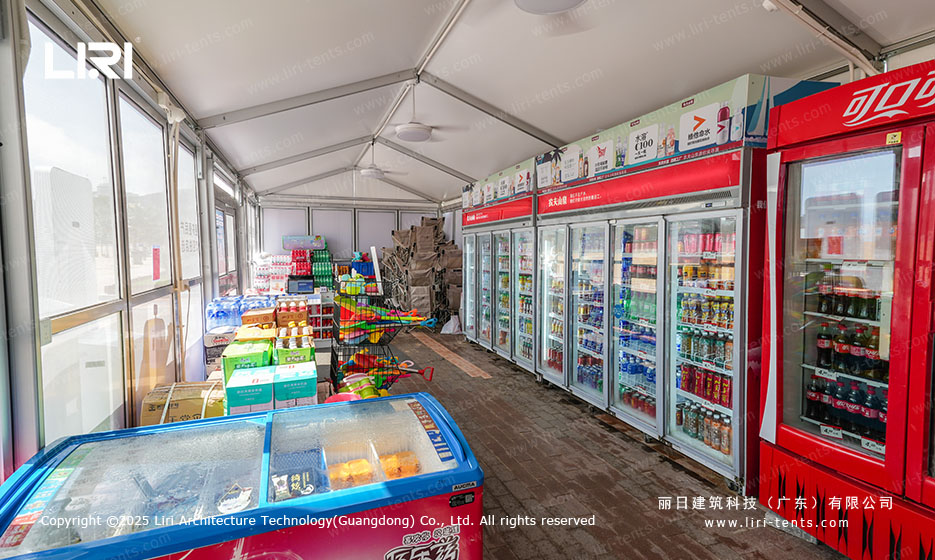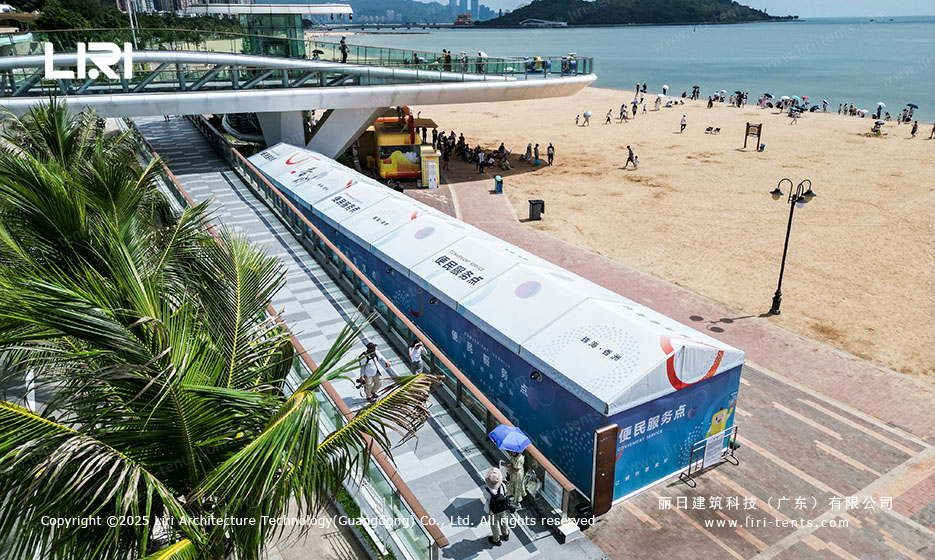
The shoreline promenade at Zhuhai’s Xianglu Bay draws several thousand visitors each weekend, and a permanent brick-and-mortar café would have meant a six-month permitting cycle plus a coastal construction review.
To capture that traffic without the wait, the operating team commissioned a 30x35m equestrian arena tent horse riding shelter-style linear aluminum frame tent, a custom-made party tent engineered to the same load-bearing standards but configured as a fixed small-shop structure. Measuring roughly 18m by 3.5m, the long-axis footprint follows the curve of the boardwalk, leaving the sandy beach entirely unobstructed on the seaward side.
Why a Coastal Site Demands a Different Class of Tent
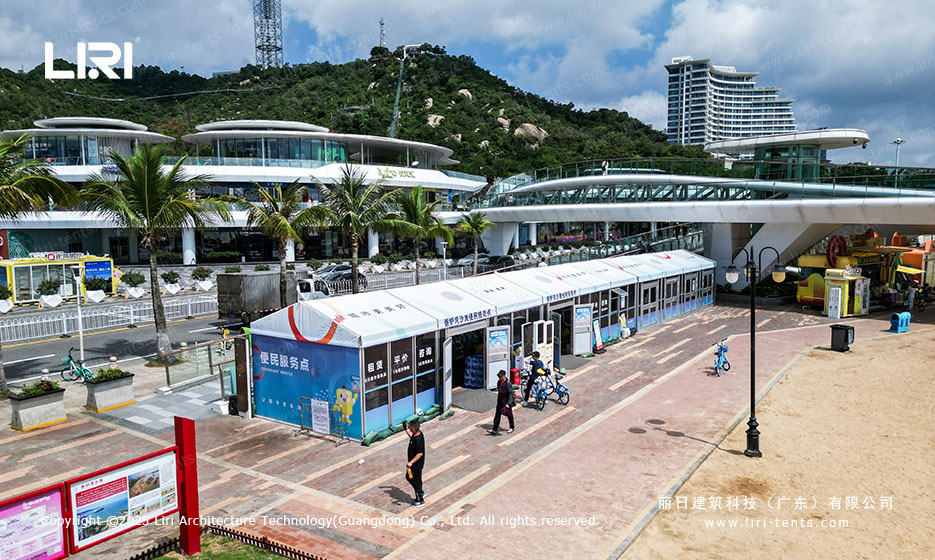
Salt-laden air is the silent killer of ordinary outdoor structures. Standard hardware-store canopies will pit and rust inside a single season, and PVC fabric that wasn’t formulated with UV inhibitors will chalk and crack once the tropical sun has done its work.
The Xianglu Bay project brief was explicit: an aluminum frame tent that could sit two metres from the splash zone, run seven days a week, and stay presentable for at least five summers. For comparison, the curve roof party tent installed at a wildlife park site sits inland, where salt air is not a concern, but a beachfront concession has to clear a much higher engineering bar.
What the Engineering Team Adjusted for Salt and Wind
Three small choices made the difference between a kiosk that lasts one summer and one that lasts a decade.
First, every aluminium profile is anodized to a 25-micron marine-grade spec, then the bolted connections are capped with stainless-steel dome nuts to keep spray from pooling in the joint.
Second, the roof panels use a 850gsm PVC with a UV-block coating on both faces, mechanically tensioned so that the typhoon-rated wind load is distributed across every bay rather than concentrated at the eaves. Third, the entire structure is anchored on a series of ballast plates rather than drilled-in anchors, which means the operator can lift, reposition, or redeploy the kiosk if the promenade layout changes between seasons.
Combined, these adjustments produce a clear span aluminum sports hall for tennis court shelter-class aluminium pavilion that weighs roughly the same as a comparable indoor structure but tolerates the spray zone year-round.
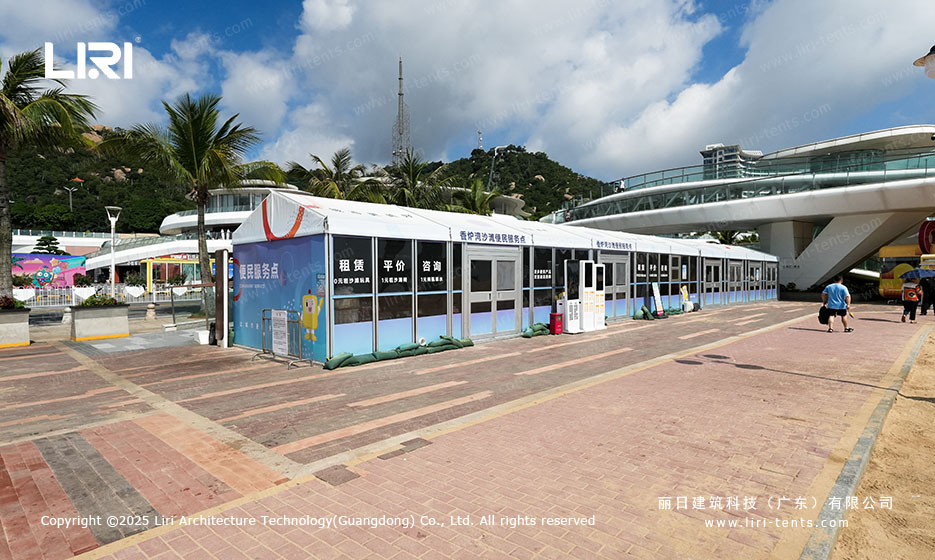
How the Branded Wrap Turns a Tent into a Shopfront
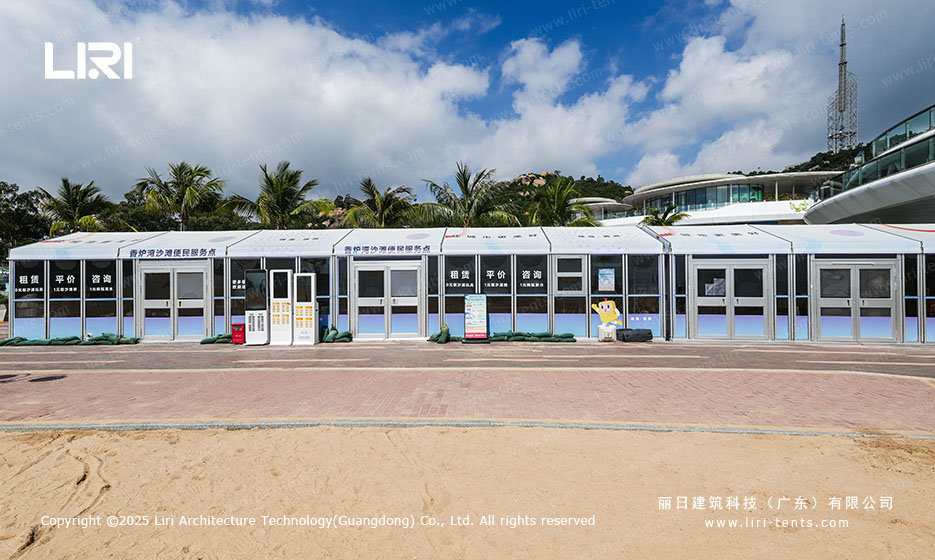
A plain aluminium frame on a busy boardwalk reads as a temporary structure, and temporary structures struggle to earn repeat customers.
To convert the modular structure tent into a recognizable retail address, the operator wrapped every wall panel with a high-resolution dye-sublimation print in the brand’s signature blue, finished with a printed service-point sign and a translucent entry curtain.
The same trick has been used on the clear span tent for a commercial plaza activation at a commercial plaza, where the graphics were updated for each activation — proving the wrap system is not a one-off expense but a reusable branding surface.
How the Kiosk Performs Through the First High Season
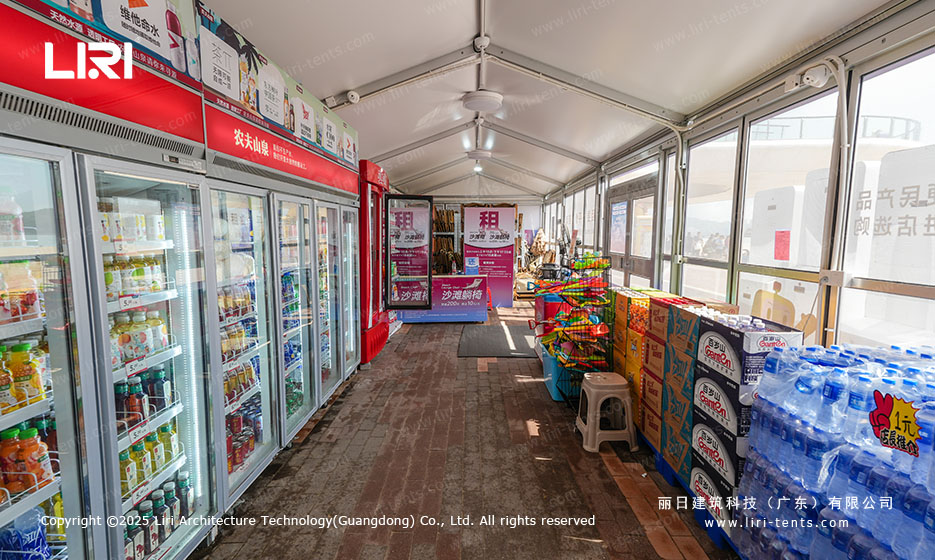
After three months of continuous operation, the numbers tell a clean story.
The kiosk averages 320 transactions per day, peaks of 600 during public holidays, and zero weather-related closures — the typhoon-alert shutdowns that would have closed a conventional shop are absorbed by the ballast system in under an hour.
Daily maintenance is a 15-minute routine: a freshwater rinse of the lower frame, a quick wipe of the entry curtain, and a visual check of the tension straps. For an operator weighing arc roof clear top tents for outdoor parties-style weatherproof outdoor marquee options against permanent construction, this kiosk case demonstrates the real-world performance ceiling: enough to outlast a comparable tent setup while costing roughly a third of a built storefront.