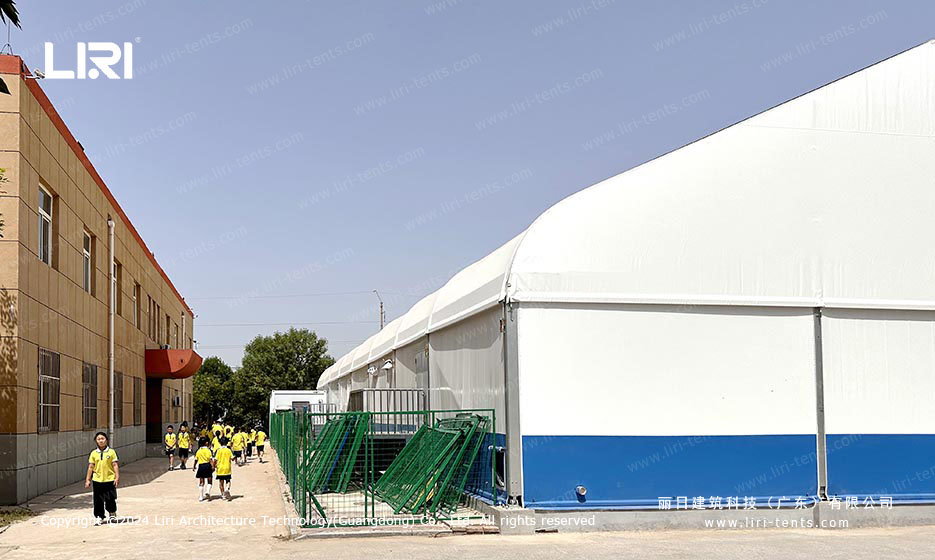
When a primary school in Linyi needed a dedicated space for student swim training and aquatic physical education classes, conventional brick-and-mortar construction would have taken months and blown past the budget entirely.
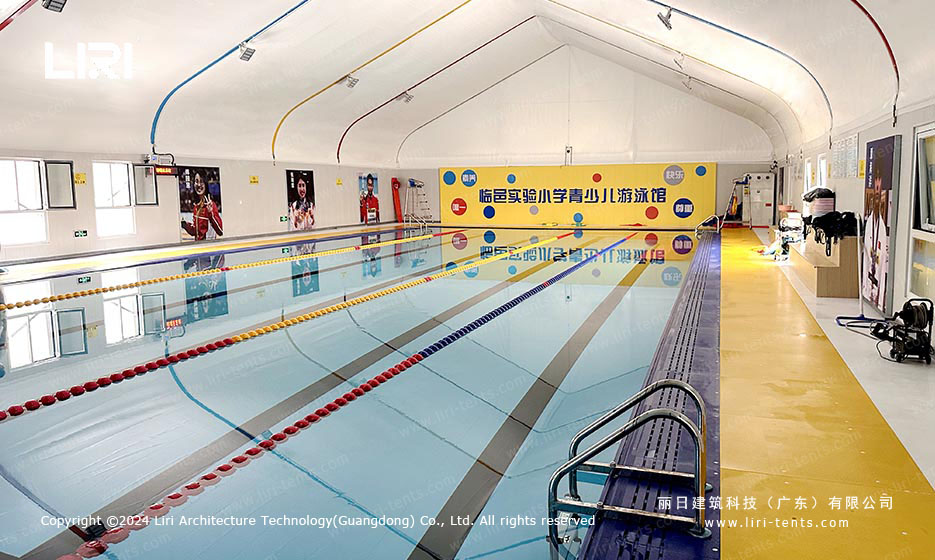
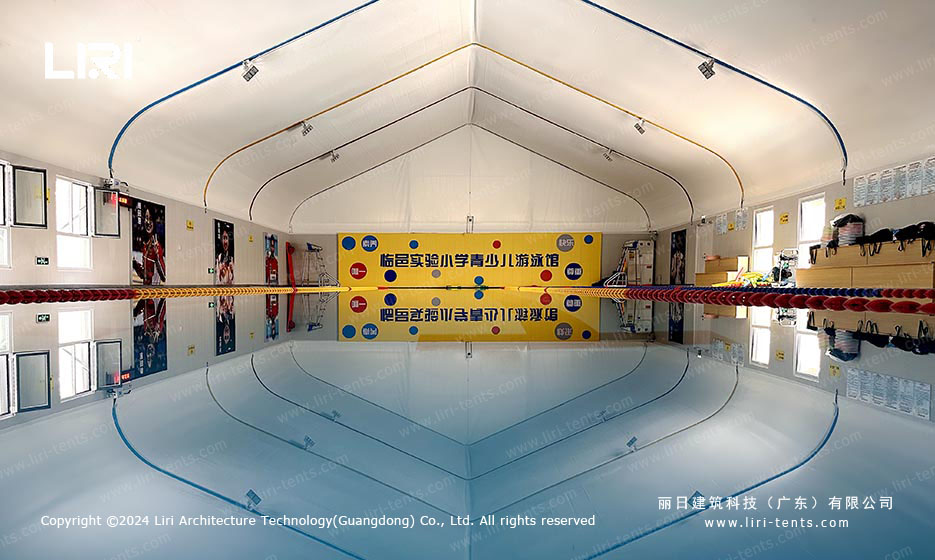
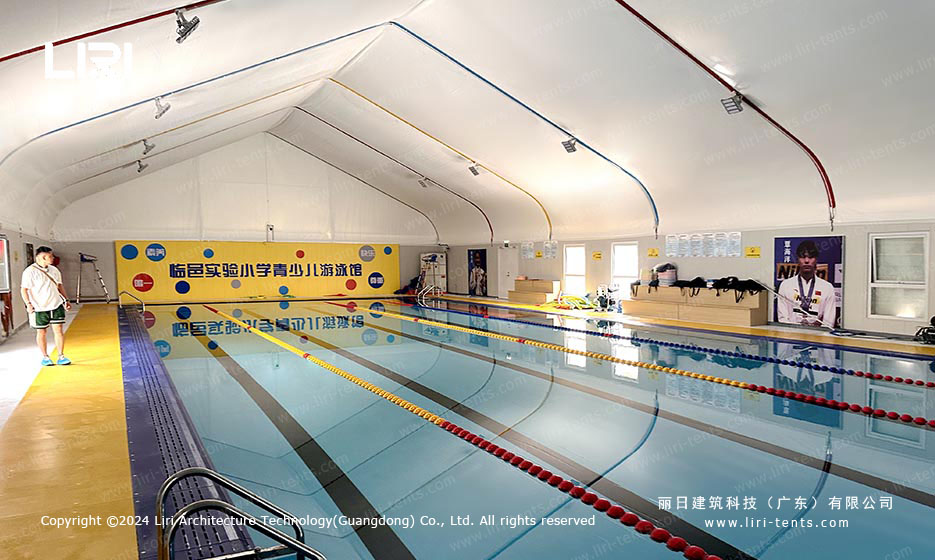
Instead, the school turned to a 15m clear span aluminum frame tent measuring 38 meters in length to create a fully enclosed indoor swimming pool shelter in a fraction of the time. The result is a bright, climate-controlled aquatic center that houses a competition-style pool complete with lane dividers, starting blocks, spectator seating areas, and dedicated deck zones on both sides.
This project demonstrates how clear span party tent structures have moved far beyond temporary event coverage into permanent institutional applications.
Structural Engineering Behind the 15m x 38m Pool Enclosure
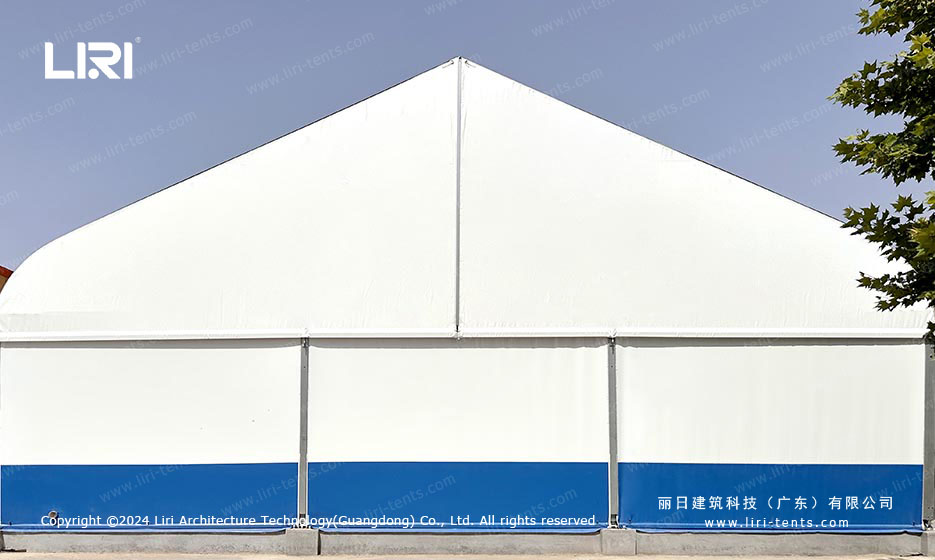
The enclosure uses a hard-pressed extruded aluminum alloy frame with a 15-meter clear span width, meaning there are zero internal columns obstructing the pool area below. This column-free design is critical for swimming facilities where coaches need unobstructed sightlines across all lanes and swimmers require full overhead clearance for diving starts and stroke mechanics.
The main frame profiles are manufactured from 6061-T6 aluminum, delivering a strength-to-weight ratio that steel simply cannot match while remaining completely corrosion-resistant against the high-humidity environment inside an active pool hall.
The roof cover is fabricated from 850g/m² PVC-coated polyester fabric in a two-tone scheme—white across the upper sections to reflect solar heat gain and reduce cooling loads, with a deep blue lower band that visually anchors the structure to ground level.
Internally, the arched ceiling features tensioned cables in blue, red, and yellow that serve dual purposes: they act as secondary load-distribution members under wind and snow pressure, and they provide mounting points for LED lighting fixtures positioned evenly along both sides of the pool.
Side walls incorporate transparent window panels that allow natural daylight to reach the water surface while maintaining a sealed thermal envelope—essential for keeping heating costs manageable during colder months. These engineering choices make the structure functionally equivalent to a permanent building at roughly one-third the construction timeline.
From Event Shelter to Institutional Aquatic Center
The interior layout reveals how thoughtfully the space was planned around actual swim training workflows. A standard six-lane competition pool occupies the central bay, marked by red and yellow floating lane dividers anchored at each end. One side of the pool features a continuous yellow non-slip deck wide enough for swimmers to stage between sets, while the opposite flank houses equipment storage, a timing station, and a raised coaching platform.
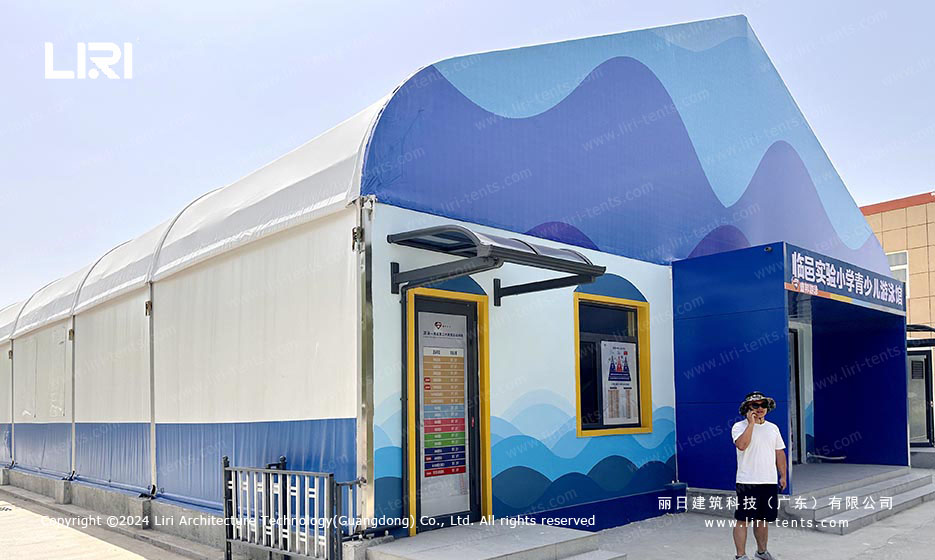
At the entrance end, the design team incorporated a custom facade treatment with ocean-wave graphics in graduated blues—subtle branding that signals the building’s purpose before visitors even step inside. The entrance itself uses a glass-panel door system set within a rigid aluminum doorframe, providing daily durability against hundreds of student entries and exits.
What makes this installation particularly noteworthy is its dual identity as both a commercial event tents derivative and a purpose-built sports facility. The same modular aluminum profile system used here for a pool enclosure can be reconfigured for sporting event tents for sale, trade show halls, or warehouse expansions.
For schools and athletic organizations evaluating options, the key advantage is speed—a structure of this scale can go from bare ground to fully operational in under eight weeks, versus six to twelve months for traditional construction. The fabric membrane also offers a practical benefit specific to pool environments: it does not absorb moisture or develop mold the way drywall and insulation can, significantly reducing long-term maintenance overhead for facility managers.
Getting Started With Your Own Sports Facility Enclosure Project
If your organization is evaluating options for a new aquatic center, court cover, or multipurpose sports shelter, a clear span aluminum tent deserves serious consideration alongside traditional construction methods.
The project documented here proves that these structures deliver genuine institutional-grade performance—not temporary patch solutions—when properly specified with appropriate fabric weights, frame profiles, and environmental control systems.
Request a preliminary engineering assessment that includes localized wind/snow analysis, foundation recommendations, and a phased installation timeline tailored to your site conditions and operational calendar.