Modular party tents have become the default venue solution for company events that outgrow meeting rooms but do not justify a permanent hall. The concept is simple: a clear-span aluminum frame and PVC cover that can be assembled in standard bays, extended by adding modules, and configured around whatever the event needs — a single 3x5m unit for a small team dinner, or a 20x80m structure for a full product launch with multiple zones. Because the footprint grows by splicing modules, the same equipment scales from a birthday-scale gathering to a corporate-wide celebration.
The practical advantage shows up in the space itself. There are no internal poles to work around, so the floor plan is entirely the designer’s: stage and seating in one zone, dining in another, breakout areas and registration at the edges. Companies that run recurring events — quarterly town halls, client days, team-building weekends — treat the tent as reusable infrastructure rather than a one-off rental, which changes how they spec frame quality and fabric grade.
Why Modular Beats Fixed-Size Tents for Company Events
Fixed-size tents force a compromise: either you book extra capacity you will not use, or you squeeze an event into a footprint that is slightly too small. Modular systems remove that trade-off because the footprint changes with the event. A base module of 3x5m or 5x5m is the building block, and the layout grows by adding bays along the ridge line. If a workshop expands from 40 to 60 people, the crew adds a module instead of renegotiating a whole new structure.
There is a structural reason this works: modular frames distribute load through a continuous ridge and post system, so every added bay carries its share of the roof weight. The standard profile handles the same wind and snow loads whether the tent is 10m or 50m long, which is why rapid-install modular tents for athletics and similar multi-bay projects rely on the same engineering. Interior fit-out — flooring, lighting, HVAC, and walls — also stays consistent across modules, so the second event looks as finished as the first.
Configuring a Modular Tent for Corporate Use
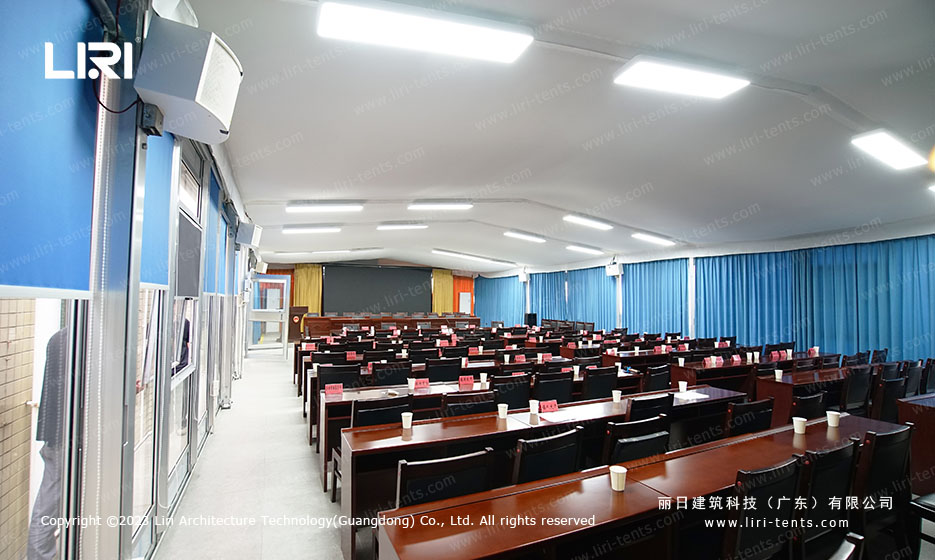
The layout freedom is the reason modular tent layout options dominate corporate planning documents, and modular tent types for business events cover everything from town halls to product launches. Corporate events put different demands on a tent than weddings or festivals. Sound matters: a solid wall system with acoustic panels keeps a keynote audible in a 300-seat configuration. Lighting matters more at night, so most company setups include a lighting truss or multiple LED zones rather than string lights. And branding is usually non-negotiable — roof panels and gable ends carry printed company graphics, and sidewalls accept additional signage without affecting the structure.
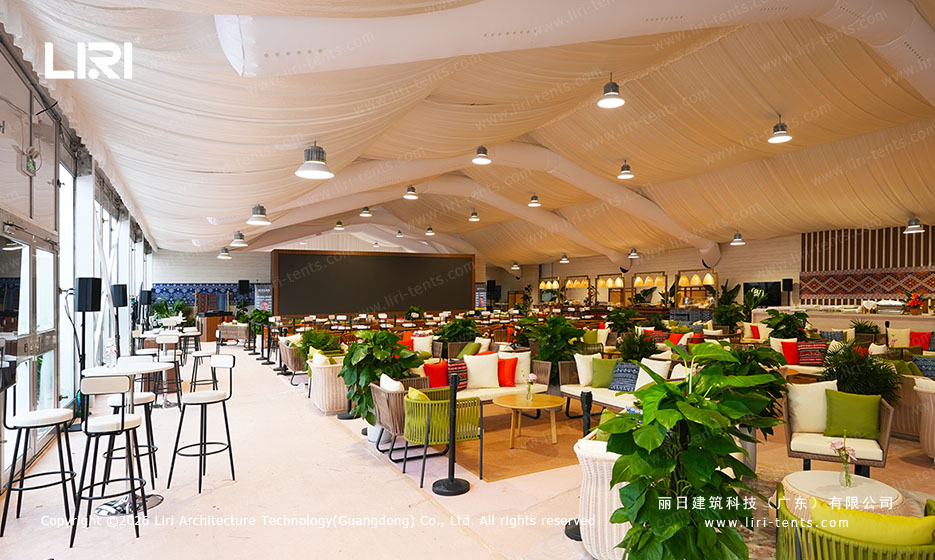
Climate control is the piece that separates a comfortable corporate venue from an uncomfortable one. Modular tents accept HVAC duct ports in the sidewall, allowing portable AC units or forced-air heaters to keep a 500m2 space at a consistent temperature through the event. For multi-day events, adding an interior lining also reduces condensation and improves the acoustics, and modular party tent flooring systems create a level, clean surface that protects shoes and equipment alike.
Cost Model: Buy vs. Rent vs. Splicing Modules
The cost structure of modular tents is transparent because it scales linearly. A base unit in the 3x5m class carries the lowest price, and the total rises with the number of combined modules. Material choice moves the number too — an aluminum frame with standard PVC tarpaulin is the conventional configuration, while stainless steel frames or upgraded waterproof fabrics such as PVDF cost more and add wind and snow resistance. Functional extras — flooring, air conditioning, transparent windows, ventilation — are priced per module, and custom decoration such as logo printing is a separate line item.
For ownership, expect a purchase price in the thousands for a base module, with larger multi-module installations priced by specification. For one-off events, rental by the day is the economical route since the supplier handles delivery, construction, and demolition. Many companies start with rental for a pilot event, then move to purchase once the recurring-use case is proven — the same footprint can be reused across town halls, client events, and product launches through the year.
Project planning for corporate events follows a standard sequence: confirm the guest count and program, lock the footprint and zones, then specify walls, flooring, lighting, and climate control in that order. Most suppliers provide a layout drawing service that shows module positions, door openings, and service points before anything is ordered, which eliminates the site surprises that show up on event day. Delivery windows, crew requirements, and site access are all documented in the quote, so the event team knows exactly what arrives on site and when.